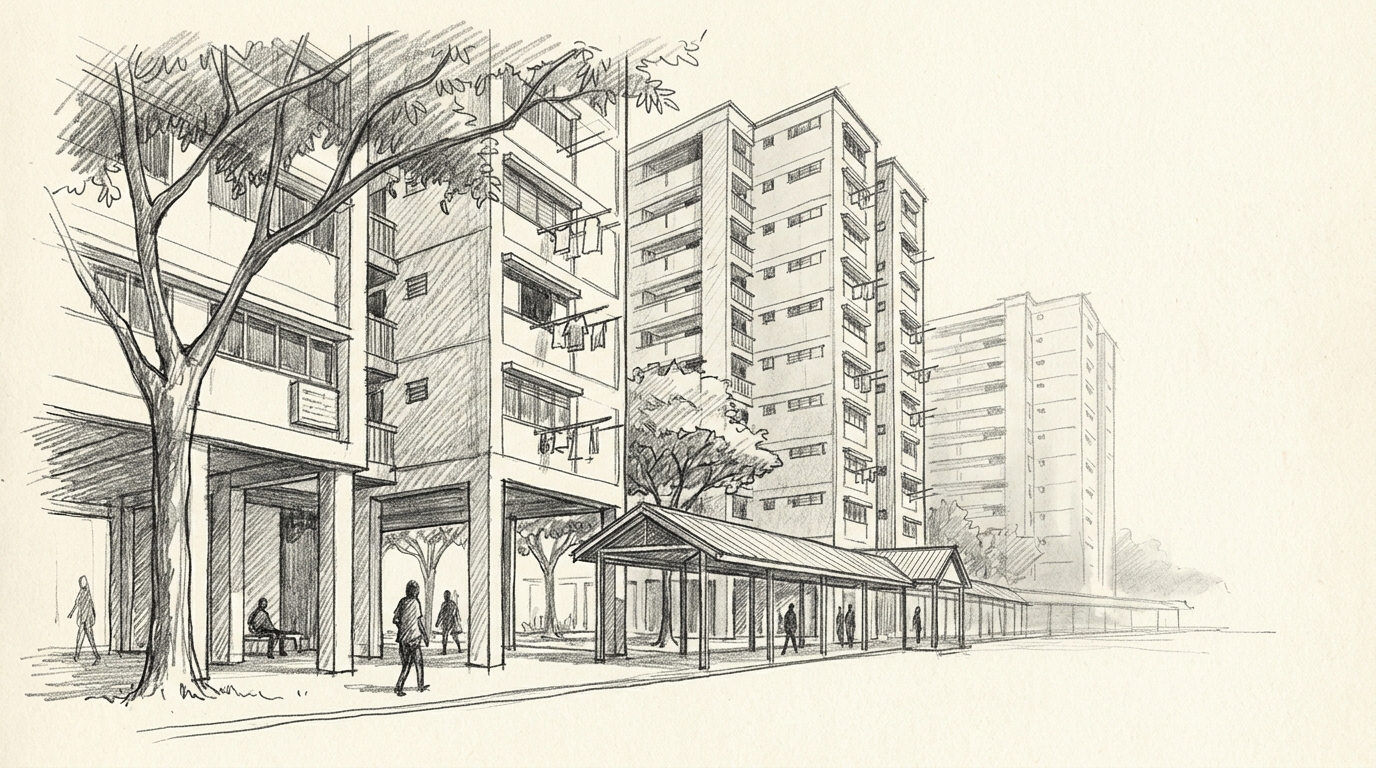
Co-Living vs Renting an HDB With Friends: The Real Cost Comparison
Is it cheaper to rent an HDB with friends or get a co-living room? A real 2026 Singapore cost breakdown, hidden costs, and a pre-lease checklist.

Renting a whole HDB flat with friends usually looks cheaper on paper. Split a 4-room flat four ways and the rent per head can beat a co-living room. But once you add the deposit, agent fee, furniture, and the risk of a flatmate breaking the lease, the gap shrinks fast, and for some setups it disappears completely. The honest answer is: it depends on how long you're staying, how much furniture you already own, and how much admin you're willing to take on.
This piece breaks down both options with real 2026 numbers, so you can do the maths for your own situation instead of guessing.
Two Ways to Share, Priced Honestly
There are really only two models here, and they get compared unfairly all the time because people only count the headline rent.
Co-living means renting a single furnished room inside a shared flat run by an operator. You get your own room, shared common areas, and one all-in monthly bill that usually covers wifi, utilities, and cleaning of common spaces. Leases tend to be shorter and more flexible than a standard tenancy.
Whole-flat group rental means you and your friends sign (or should sign) a tenancy agreement directly with the flat owner, split the rent, and furnish the place yourselves. Everyone on the agreement is typically jointly and severally liable, which matters more than most first-time renters realise.
Both Options Priced for 2026
A 4-room HDB flat rented as a whole unit is going for roughly S$2,500 to S$2,700 a month on average across Singapore in 2026, based on recent transaction data, with plenty of variation by location. Split four ways, that's around S$625 to S$675 per head before anything else gets added on.
Co-living rooms in 2026 run across a wider band because room type matters a lot. Budget or compact rooms sit around S$600 to S$900. Common rooms typically land between S$1,000 and S$1,600. Master bedrooms or ensuite rooms run S$1,700 to S$2,500 and up, especially in central locations. Most of these prices are all-in, meaning wifi, utilities, and often cleaning are already bundled.
So on base rent alone, splitting a flat wins. The comparison only gets honest once you add what the flat split leaves out.
Co-Living Room vs a Quarter of a Four-Room Flat
| Co-living room | 1/4 share of a 4-room HDB | |
|---|---|---|
| Base monthly cost | S$1,000 to S$1,600 (common room, all-in) | Roughly S$625 to S$675 (rent only) |
| Deposit | Usually 1 month | Typically 2 months' rent plus 1 month advance, split among the group |
| Agent fee | None, operator-run | Often half a month to a full month's rent, split among tenants |
| Furniture and appliances | Included | Group buys or rents beds, wifi router, fridge, washing machine |
| Lease flexibility | Often month-to-month or short notice | Usually a 12 to 24 month lease, hard to exit early |
| Utilities and wifi | Bundled into one bill | Split manually, a common source of friction |
| If one person leaves | Only affects that room | Often everyone still owes the full rent until it's sorted |
The co-living number looks higher on the surface. But it's the only row in this table where the number you see is the number you pay, with nothing else stacked on top.
7 Hidden Costs of Renting With Friends
These are the costs that don't show up when someone posts "rent is only $650 each" in the group chat.
- The security deposit. Typically 2 months' rent, tied up for the entire lease and only refunded if the flat comes back in original condition.
- Agent commission, if you used one to find the place, often split awkwardly among however many tenants actually show up to sign.
- Furniture and appliances. Beds, a fridge, a washing machine, aircon servicing. None of this is included in a bare rental.
- Wifi setup. A router, installation, and a monthly bill that someone has to own and chase everyone else for.
- Utility overages. Aircon-heavy habits in a shared flat add up fast, and utility bills need to be split manually every single month.
- Move-out costs. Cleaning, touch-up painting, replacing anything damaged, and the very real risk of a partially forfeited deposit over a dispute nobody agreed on upfront.
- The empty-room risk. If one flatmate leaves early, the rest of the group usually still owes their share of the full rent until a replacement is found and approved by the landlord.
Myth: Renting With Friends Is Always Cheaper
This is the one assumption that gets people into trouble. On raw rent per head, sharing a flat usually is cheaper than a co-living room of similar size. That part is true.
What's not true is that it stays cheaper once you spread the deposit, agent fee, and furniture spend across a typical stay. For a short stay under a year, or for a first-time renter who owns no furniture, the upfront costs can wipe out most of the per-month saving. The maths only clearly favours a flat share when the group is staying long enough, and stable enough, to amortise all of that setup cost.
Sharing With Friends for the First Time
If this is your first group lease, a few things catch people out every time.
Agree on the rules before you sign, not after the first disagreement. Who's the lead tenant on paper. How bills get split and who chases late payments. What happens if someone's partner moves in unofficially.
Know that the tenancy agreement usually makes everyone jointly liable. If one person stops paying, the landlord can legally come after the rest of the group for the full amount, not just their share.
Keep a paper trail on shared expenses from day one. A shared spreadsheet or a bill-splitting app saves every friendship in the group once the inevitable "who paid for what" question comes up three months in.
Mistakes: Splitting Rent and Forgetting Everything Else
The most common mistakes aren't about the rent number itself. They're about everything that gets assumed rather than agreed.
Not checking that the flat's total headcount is properly registered, which matters because unregistered subletting leaves tenants with no real recourse if something goes wrong. Only one person's name going on the tenancy agreement while three others pay them informally, which leaves those three with zero legal standing. No written agreement on what happens if someone wants to leave early. Assuming the "cheaper per head" number is the whole story without ever adding up the deposit, agent fee, and furniture spend against it.
Checklist: Run This Before You Sign a Group Lease
- [ ] Confirm the flat's total household size fits within the legal occupancy cap for unrelated tenants (currently up to 8 in a 4-room or larger flat, a relaxation extended to end-2028)
- [ ] Confirm the subletting is properly registered with HDB, and ask to see the approval
- [ ] Every sharer's name goes on the tenancy agreement, not just one "lead tenant"
- [ ] Deposit split and refund process agreed in writing before move-in
- [ ] Utilities and wifi arrangement decided upfront, one bill under one name or a fixed split
- [ ] An exit clause covering what happens if one person leaves early
- [ ] Furniture and appliance costs budgeted and split before move-in day
- [ ] Compare the true all-in monthly cost per head, deposit and furniture included, against a co-living room in the same area
If the group-lease admin above sounds like more than you want to take on, a single co-living room skips the deposit-splitting, the furniture shopping, and the joint-liability tenancy agreement entirely. Lazybee runs furnished rooms across a few Singapore neighbourhoods, with live availability and pricing listed at lazybee.sg.
FAQ: Group Renting, the Questions to Settle First
Is it cheaper to rent an HDB with friends than co-living? Usually cheaper on base rent per head, but the gap narrows or disappears once you add the deposit, agent fee, and furniture, especially for a stay under a year.
How much deposit do I need to rent an HDB with friends? Budget around 2 months' rent as a security deposit plus 1 month advance rent, split across the group, on top of any agent fee.
Can PRs rent a whole HDB flat with friends? Yes, as tenants. The restriction is on the owner's side, only a Singapore Citizen owner can sublet a whole flat, and a non-citizen quota can apply to the tenant mix.
What happens if one friend wants to move out early? Depends entirely on what's written into the tenancy agreement. Without an exit clause, the remaining tenants are often still on the hook for the full rent until a replacement is found and approved.
Is co-living more flexible than a shared HDB lease? Generally yes. Co-living leases tend to run shorter and allow shorter notice periods, while a standard HDB tenancy is usually locked in for 12 to 24 months.
How many people can legally live in one HDB flat? Up to 8 unrelated persons in a 4-room flat or larger, under the temporary occupancy cap relaxation that HDB and URA extended to end-2028.
Figures here that come from government schedules, MOM salary thresholds, ICA and HDB requirements, URA rules, fees and fares, are reviewed on their own timetables and move. Check the current number at the source before you rely on it.