Moving to Singapore From Taiwan: A Co-Living Housing Guide
Moving to Singapore from Taiwan? Here's the pass you need, realistic housing costs, and how co-living fits your first few months.
Moving to Singapore from Taiwan is relatively straightforward on the entry side, since Taiwanese ROC passport holders get 30 days visa-free for business or social visits, enough time to fly in, view rooms, and start paperwork. The part that trips people up isn't the border, it's housing. Entering visa-free doesn't let you sign a lease. You need a Student Pass or a work pass, Employment Pass or S Pass, actually issued in hand, not just a school offer letter or an internal transfer memo.
For most people arriving from Taiwan, whether for graduate study, a tech or finance role, or a company posting, the practical move is a furnished co-living room booked for the first few months, then a longer-term decision once the pass clears and the daily routine is settled.
Do I Need a Visa Just to Enter Singapore From Taiwan?
No, not for a short visit. Taiwan ROC passport holders can enter Singapore visa-free for up to 30 days for business or social purposes. That's enough for a job interview, a university open day, or a solid week of room viewings before your pass is issued, though it's tighter than the 90-day window some other nationalities get, so plan the trip with a purpose, not as an open-ended scouting run.
Visa-free entry and holding a valid immigration pass are two separate things, and only the second lets you sign a residential lease. If you're using part of that 30-day window to sort housing before your pass comes through, a short-term co-living booking bridges the gap far more cheaply than a hotel does over a week or two.
Which Pass Do I Actually Need Before I Can Rent?
For students, it's a Student Pass, applied for through ICA's SOLAR system by your school once you hold an offer. Processing typically takes four to eight weeks, the pass fee is S$90, and ICA issues it digitally rather than as a physical card.
For working professionals, it's an Employment Pass or S Pass, sponsored by your employer. As of 2026, the Employment Pass qualifying salary floor is S$5,600 a month (S$6,200 in financial services), scaled up for older applicants and assessed against the COMPASS points framework, with the floor rising again from 1 January 2027. The S Pass floor for younger applicants sits at S$3,300 a month (S$3,800 in financial services).
None of these passes exist until they're actually issued. An offer letter, an internal transfer memo, or an In-Principle Approval isn't the same thing, and no properly run operator will let you sign on the strength of those alone. We've covered exactly which documents a legitimate operator checks in our guide on whether foreigners can rent in Singapore.
How Far Ahead Should I Book Housing?
Line your housing search up against your pass timeline, not your flight date. A Student Pass typically clears in four to eight weeks after your school submits it, and an Employment Pass or S Pass moves on a broadly similar timeline, sometimes faster with an experienced corporate HR or immigration team handling the paperwork.
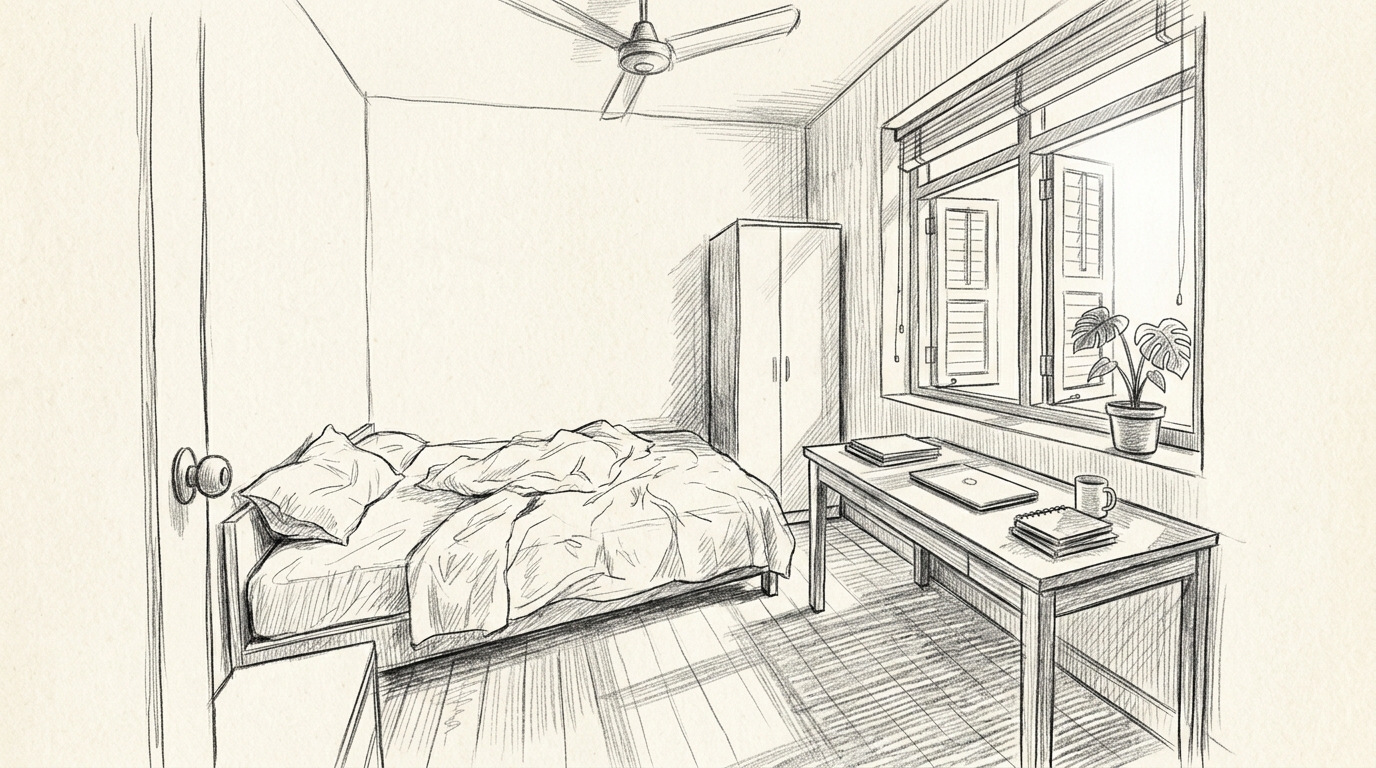
Book something short and flexible to land in, then commit to a longer lease once your pass is confirmed and your start date is fixed. This is why co-living tends to suit the first stretch better than a standard 12-month tenancy: you're not locking into a rigid contract before you actually know your pass issue date.
What Does Housing Actually Cost?
Rooms in Singapore's shared housing market run from about S$600 for a basic budget room up to S$2,500 for a private ensuite, with most standard common rooms landing between S$1,000 and S$1,600 a month. Co-living rooms, furnished and often bundled with utilities and wifi, typically sit in the S$1,200 to S$2,500+ range depending on operator and location.
Add food, transport, and a local SIM, and a realistic all-in monthly budget for a newcomer renting a room lands somewhere between S$1,800 and S$2,800. For upfront cash, budget a security deposit (standard practice is one month's rent) plus your first month, so plan for roughly two months' rent in hand before you get the keys. We've broken deposit terms down further in our guide to security deposits in Singapore co-living.
An all-inclusive co-living room removes a lot of the guesswork that's hardest to plan for from Taipei or Kaohsiung, since one number covers rent, utilities, and wifi instead of several separate bills in a currency and billing system you haven't dealt with before.
Is There a Taiwanese Community to Plug Into?
There isn't a single Taiwanese enclave in Singapore the way Tanjong Pagar functions for the Korean community, but the connections are real. Taiwan's Taipei Representative Office in Singapore, its de facto embassy given the absence of formal diplomatic ties, sits on Alexandra Road and runs consular services for Taiwanese nationals here. A Taiwan Chamber of Commerce also operates locally, useful if you want a professional network beyond your own office.
Day to day, Taiwanese bubble tea and food brands, from Chatime to Milksha, are spread across malls and heartland areas rather than clustered in one district, so a specific "Taiwanese street" isn't really a thing here. A room near your workplace or campus, on a direct MRT line, generally beats optimising for community proximity in a city this compact.
NUS and NTU both run active exchange and postgraduate pipelines with Taiwanese institutions like National Taiwan University and NTHU, so if you're arriving to study, you're unlikely to be the only Taiwanese student in your cohort.
Opening a Bank Account and Getting Set Up
You'll need your issued pass, not just an offer letter, to open an account at most banks. DBS accepts applications online and will work from an ICA In-Principle Approval plus an employer or school letter if your pass hasn't landed yet, while UOB generally expects a branch visit with your pass already in hand. Have your passport and proof of local address (your co-living agreement works for this) ready either way.
Once your card lands, day-to-day spending is easy, and contactless payment culture here will feel familiar coming from Taiwan. The bigger adjustment is usually setting up a local number and a PayNow-linked account, since a lot of everyday payments here, splitting a bill, paying a landlord, run through PayNow rather than a card or a QR wallet you're used to.
Working for a Taiwanese Company's Singapore Office
Singapore is a common regional base for Taiwanese semiconductor, electronics, and finance firms covering Southeast Asia, so a meaningful share of Taiwanese Employment Pass holders arrive on an internal transfer rather than a fresh local hire. The pass process is identical either way, since MOM doesn't run a separate track by employer nationality, though timelines can move faster when a company's HR team has handled the paperwork before.
If you're arriving on a transfer with a housing allowance attached, check exactly what it covers before signing a 12-month lease sight unseen. A short co-living booking for the first month or two keeps you flexible until you've actually seen the commute and neighbourhood in person.
Mistakes to Avoid
The most common mistake is booking a rigid, long lease before your pass is actually issued, then scrambling when the issue date shifts by a couple of weeks, which happens often enough to plan around. A second is assuming the 30-day visa-free window gives you time to spare; it's tighter than it looks once interviews, viewings, and paperwork eat into it. A third is assuming there's a single Taiwanese neighbourhood to anchor a search around, when a room on a direct MRT line to your office or campus usually serves you better than proximity to a food cluster.
A Quick Checklist Before You Book Anything
- [ ] Confirm your pass application is submitted and get a realistic issue-date estimate from your school or employer
- [ ] Budget two months' rent in cash for deposit plus first month, on top of flight and settling-in costs
- [ ] Check what's actually included in any room price (utilities, wifi, cleaning) before comparing two listings on rent alone
- [ ] Set up PayNow once your bank account is active, since a lot of local payments assume it
- [ ] Have your passport and a local address ready for your bank account application the week you land
- [ ] If you're on a company relocation package, confirm what the housing allowance actually covers before signing anything long-term
For the legal side of what makes a co-living arrangement compliant in Singapore, including minimum stay and occupancy rules, see our guide on whether co-living is legal in Singapore.
Frequently Asked Questions
Can I rent a room in Singapore before my Employment Pass is issued? No. You need the pass itself in hand to sign a standard lease or licence agreement. A short-term booking that doesn't require a long-term pass is the practical way to bridge the gap while your pass processes.
Do I need a visa to fly to Singapore from Taiwan for a viewing? No. Taiwan ROC passport holders get 30 days visa-free entry for business or social visits, enough time to view rooms and start paperwork, but it doesn't count as a long-term stay or let you sign a lease.
Is there a Taiwanese neighbourhood in Singapore like there is for some other communities? Not really. Taiwanese businesses and food brands are spread across the island rather than clustered in one district, so choosing a room near your workplace or school usually matters more day to day than proximity to a specific enclave.
Can I open a Singapore bank account before my pass arrives? Some banks, DBS in particular, will start the process using an ICA In-Principle Approval and an employer or school letter. Most still want the actual pass before the account is fully active.
Does a company relocation package change what kind of lease I should sign? Not automatically. Confirm exactly what the housing allowance covers before committing to a long lease, and consider a short, flexible booking for your first weeks while those details get finalised.
Looking for a room that's ready to move into the week you land, without a long lease locking you in before your pass is confirmed? Current availability is listed at lazybee.sg.
Figures here that come from government schedules, MOM salary thresholds, ICA and HDB requirements, URA rules, fees and fares, are reviewed on their own timetables and move. Check the current number at the source before you rely on it.
Sources: ICA, Visa Requirements; Singapore Trade Office in Taipei, Visa Information; ICA, Completion of Formalities and Issuance of Student's Pass; MOM, Employment Pass eligibility; MOM, S Pass eligibility; Taipei Representative Office in Singapore.