Moving to Singapore From Nepal: A Co-Living Housing Guide
Moving to Singapore from Nepal? Here's what EP, S Pass, and Student Pass holders can actually rent, real room costs, and how to settle in for 2026.
Moving to Singapore from Nepal, what you can rent depends on your pass, and for most Nepali nationals that means an Employment Pass, S Pass, or Student Pass, not a Work Permit dormitory. Nepal isn't on Singapore's approved source-country list for Work Permit sectors like construction, manufacturing, marine, or services, so unlike workers from several neighbouring countries, Nepali nationals in Singapore are almost entirely professionals, mid-skilled S Pass holders, students, and a smaller number here through the long-standing Gurkha Contingent arrangement. That means most of you rent privately, the normal way, and co-living is usually the fastest route to a furnished room.
This guide breaks down which pass you're likely on, what a room actually costs, and the practical steps, from banking to finding a decent plate of momo, that make the first month in Singapore easier.
Which Pass Are Most Nepali Nationals On?
Your pass decides where and how you rent, so start here.
Employment Pass (EP). For professionals, managers, and executives. The 2026 qualifying salary floor is S$5,600 a month in most sectors (S$6,200 in financial services), rising with age and assessed under the COMPASS points framework. It's set to increase to S$6,000 (S$6,600 in financial services) for new applications from 1 January 2027. Nepali professionals working in Singapore's tech, finance, and engineering sectors are typically on this pass.
S Pass. For mid-skilled roles, technicians, supervisors, and similar. The 2026 qualifying salary is S$3,300 a month in most sectors (S$3,800 in financial services), rising with age, and due to rise to S$3,600 (S$4,000 in financial services) for new applications from 1 January 2027. S Pass holders rent their own place the same as anyone on a professional pass.
Student Pass. For students enrolled at Singapore's universities, polytechnics, and registered private institutions. A Student Pass runs with your enrolment period, so plan your lease length around your course, not around a standard 12-month term.
Work Permit. This is the one that works differently for Nepal than for several other nationalities. Nepal is not currently on MOM's list of approved source countries for Work Permit holders in construction, marine shipyard, process, manufacturing, or services, the sectors where Work Permit dormitory housing is most common. In practice, this means the large majority of Nepali nationals in Singapore aren't in employer-arranged dormitories, they're renting as individuals the way EP, S Pass, and Student Pass holders do.
The Gurkha Contingent. A smaller group of Nepali nationals in Singapore serve in the Singapore Police Force's Gurkha Contingent, a recruitment arrangement with Nepal that goes back decades. Gurkha Contingent officers and their families are housed by the Singapore Police Force at Mount Vernon Camp, a completely separate system from private rental or co-living, so it isn't something this guide covers further.
For the documents each pass needs to rent, see our guide on renting in Singapore as a foreigner and our EP vs S Pass vs Student Pass renting guide.
Why Doesn't Nepal Have a Work Permit Dormitory Pathway Like Some Neighbours?
MOM sets the approved source countries and regions for Work Permit holders sector by sector, covering Traditional Sources (Malaysia, PRC), North Asian Sources (Hong Kong, Macau, South Korea, Taiwan), and Non-Traditional Sources (Bangladesh, Bhutan, Cambodia, India, Laos, Myanmar, Philippines, Sri Lanka, Thailand). Nepal doesn't appear on any of these lists for construction, marine, process, manufacturing, or services.
The practical effect is that if you're a Nepali national planning to work in Singapore outside the Gurkha Contingent, you're almost certainly coming in on an EP, S Pass, or Student Pass, which means you'll be arranging your own housing from day one, not waiting on an employer to sort a dormitory bed.
What Does a Room Actually Cost?
Room prices vary by type, location, and how central the neighbourhood is. The honest range across the market in 2026 looks roughly like this:
| Room type | Typical monthly rent |
|---|---|
| Compact or budget room | S$600 to S$900 |
| Common room | S$1,000 to S$1,600 |
| Master bedroom (ensuite) | S$1,700 to S$2,500+ |
Co-living rent usually bundles in wifi, utilities, and furnishing, so the number you see is close to your real monthly cost, unlike a bare HDB or condo room where those get billed separately on top. We don't quote a fixed figure here since it changes by room and by month. Current availability and pricing for Lazybee's Chiltern Park, Ivory Heights, and Thomson Grove rooms are listed on lazybee.sg.
On top of rent, budget for a security deposit, usually one month's rent, refundable at move-out barring real damage. Our security deposit guide covers what's standard and how to get it back cleanly.
Why Co-Living Works Well for a First Move
If you're arriving on an EP, S Pass, or Student Pass with no local track record, renting solo usually means chasing a guarantor, signing a 12-month tenancy, and furnishing an empty flat from scratch. That's a hard ask if you've landed with a suitcase and a start date the following week.
- No guarantor chase. Most co-living operators verify your pass and income directly, rather than requiring a local guarantor the way some private landlords ask of first-time renters.
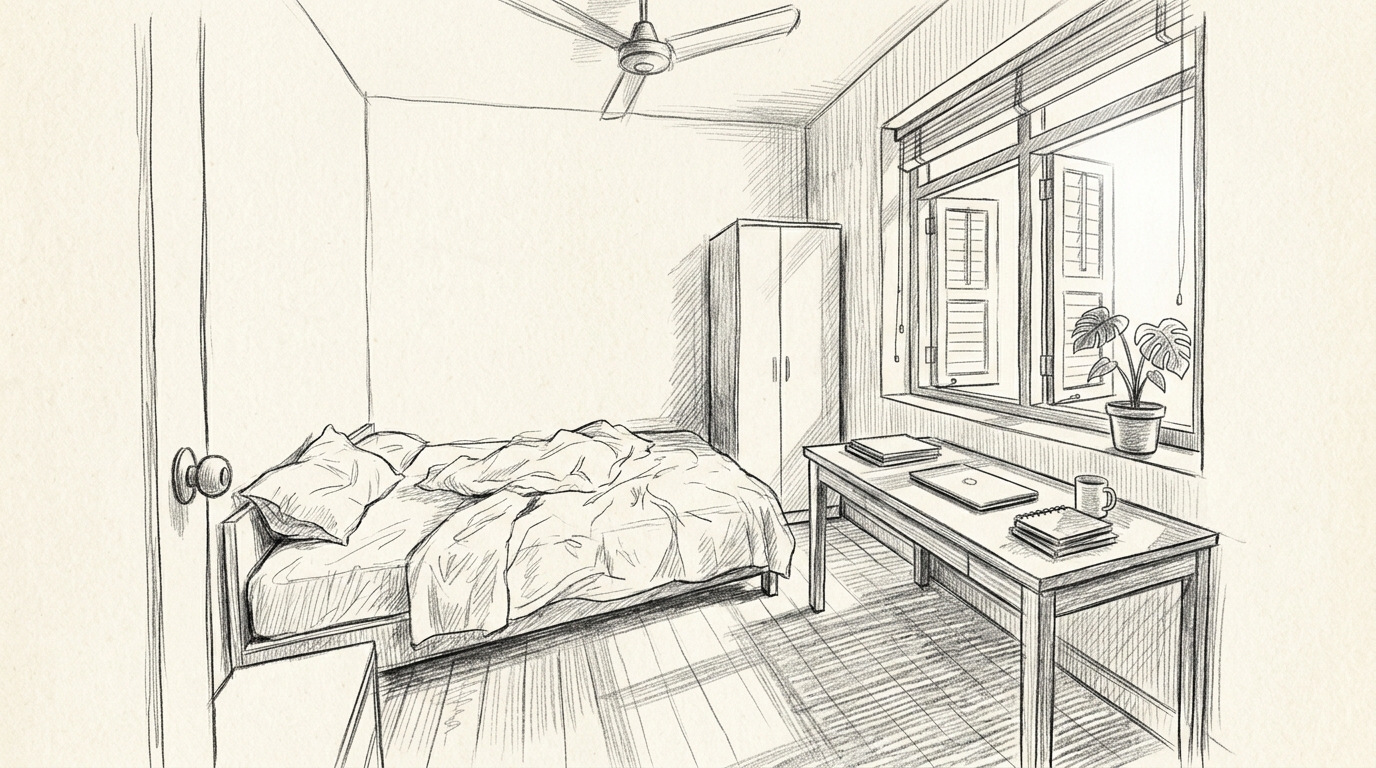
- Furnished from day one. Bed, wardrobe, wifi, and often a shared kitchen are already set up.
- Shorter, more flexible lease terms. Useful if your Student Pass or S Pass doesn't comfortably cover a standard 12-month tenancy.
- Built-in community. Landing in a new country is easier with housemates around, even on the weeks you keep to yourself.
Settling In: The Practical Stuff
A few things worth sorting in your first month, separate from the housing question.
Banking. DBS, OCBC, and UOB all open accounts for foreigners holding a valid pass and passport, usually in person at a branch once you have a residential address. Having your room confirmed before your bank appointment saves a step, since some branches ask for an address on file.
Nepali food and community. Chander Road, just off Little India, is home to a couple of the city's best-known Nepali restaurants, serving momo, thukpa, and other home comforts. Momo.sg at Tekka Centre in Little India is another well-known spot. The Nepalese Society Singapore, a community organisation registered since 2008, runs sports and social clubs, including badminton, futsal, and hiking groups, if you're looking to meet other Nepalis outside your workplace or campus.
SIM and connectivity. A local SIM from Singtel, StarHub, or M1 needs your passport and pass on hand, and can usually be sorted same-day at a mall outlet.
Remittance. Money transfer agents around Little India and Serangoon handle remittances home, alongside the major banks, which all offer international transfer services to Nepal.
Before You Sign: What to Check
- Your pass is issued and in hand, not just an offer letter or in-principle approval.
- The lease length doesn't outlast your pass validity, especially on a Student Pass.
- Deposit terms and the refund process are written into the agreement, not just promised verbally.
- The room count and floor area match what's actually advertised. Our guide on is co-living legal in Singapore covers the minimum stay and occupancy rules every legitimate room should already meet.
Frequently Asked Questions
Can Nepali nationals get a Work Permit for construction, services, or manufacturing jobs in Singapore? Nepal isn't currently on MOM's approved source-country list for Work Permit holders in these sectors, unlike several neighbouring countries. Most Nepali nationals in Singapore are here on an Employment Pass, S Pass, Student Pass, or through the separate Gurkha Contingent arrangement.
What's the minimum salary for an S Pass or Employment Pass in 2026? S Pass is S$3,300 a month in most sectors (S$3,800 in financial services), rising with age. Employment Pass is S$5,600 a month in most sectors (S$6,200 in financial services), also rising with age and assessed under COMPASS.
How much should I budget for a room in Singapore? Realistically S$600 to S$2,500+ a month depending on room type and location, plus a deposit of around one month's rent. Check current listings for exact pricing since it moves by room and by month.
Is there a Nepali community in Singapore? Yes. Nepalis in Singapore span EP and S Pass professionals, students, and the Gurkha Contingent. Chander Road near Little India has a couple of well-known Nepali restaurants, and the Nepalese Society Singapore runs community and sports clubs.
Do I need a guarantor to rent as a Nepali national on an EP or S Pass? Not usually with a co-living operator, since they verify your pass and income directly. Some standalone landlords still ask for one, particularly for first-time renters with no local rental history.
Looking for a furnished room with the paperwork done properly and no guarantor chase? Browse current availability at lazybee.sg.
Figures here that come from government schedules, MOM salary thresholds, ICA and HDB requirements, URA rules, fees and fares, are reviewed on their own timetables and move. Check the current number at the source before you rely on it.
Sources: MOM, S Pass eligibility and salary; MOM, Employment Pass eligibility and salary; MOM, Work Permit construction sector requirements and approved source countries; MOM, Non-Traditional Sources Occupation List; Nepalese Society, Singapore.