Housing for Engineering Students Near Campus Labs
Housing for engineering students near campus labs at NUS and NTU: why FYP crunch and workshop access make proximity matter more, and where to live.
Engineering students at NUS and NTU should weight campus proximity more heavily than most other students, because so much of the degree happens in a lab or workshop, not a lecture hall. NUS's engineering programmes sit within the College of Design and Engineering (CDE) on the Kent Ridge campus, and NTU's sit within the College of Engineering on the main Nanyang campus in Jurong West. Both put lab and project work on a schedule the timetable doesn't control, which is exactly why a short commute matters more here than it does for a course that's mostly seminars and readings.
This guide covers why that's true specifically for engineering, not students in general, and where that leaves you if you're choosing a room near either campus.
Why Engineering Is Different From a Lecture-Heavy Degree
A lot of degrees run entirely on a published timetable: class starts, class ends, you go home. Engineering doesn't work that way for long stretches of the course. Lab modules, project teams, and specialised equipment mean the actual work often continues after the timetabled session is over, and it isn't always something you can pick back up from a laptop at home.
NUS's Faculty of Engineering, now folded into CDE alongside the School of Design and Environment since 2021, was established in 1968 and is the largest faculty in the university (Wikipedia). NTU's College of Engineering is NTU's largest academic division, with a student population of more than 10,500 undergraduates and 3,500 graduate students across five schools (Wikipedia). At both universities, engineering isn't a small corner of campus. It's the biggest single group of students working through lab-based coursework at any given time, which is part of why lab and workshop capacity gets tight exactly when everyone needs it most, around deadlines.
Where NUS's Engineering Facilities Actually Are
CDE, and the engineering departments within it, sit on the Kent Ridge campus, with a listed address of 9 Engineering Drive 1 (NUS CDE). That places engineering teaching and lab space within the main Kent Ridge grounds, reachable the same way as the rest of campus: Kent Ridge MRT (CC24) on the Circle Line, with one-north and Buona Vista the next two stops out, all connected by NUS's free internal shuttle.
For the fuller rundown of Kent Ridge's transport links, hall odds, and the neighbourhoods around campus, see our guide to student housing near NUS. This piece stays focused on why engineering specifically raises the stakes on that commute, not on repeating the campus-wide basics.
Where NTU's Engineering Facilities Actually Are
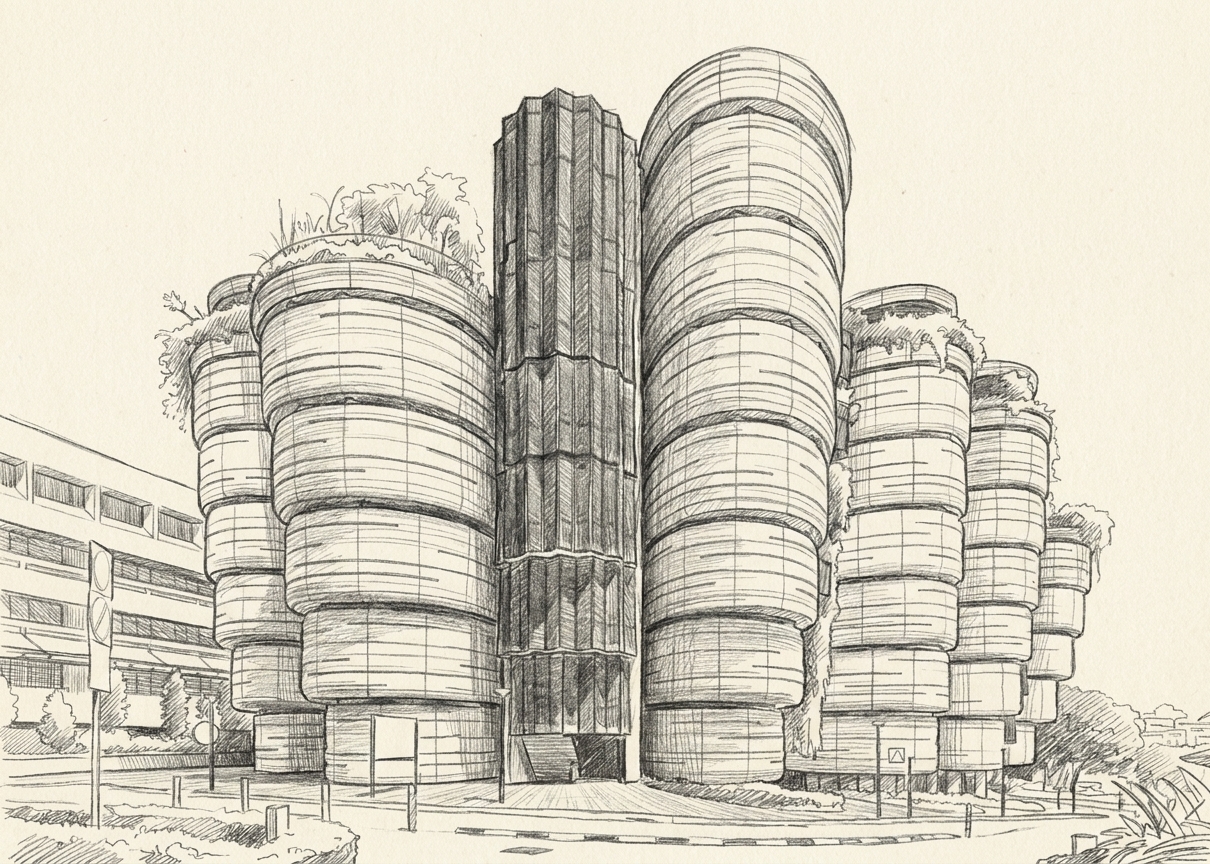
NTU's College of Engineering runs across five schools: Chemistry, Chemical Engineering and Biotechnology; Civil and Environmental Engineering; Electrical and Electronic Engineering; Mechanical and Aerospace Engineering; and Materials Science and Engineering (Wikipedia). All of it sits on NTU's main campus in Jurong West, the same campus covered by Pioneer and Boon Lay MRT and NTU's own shuttle network.
For the transport breakdown, the shuttle system, and how Boon Lay, Pioneer, and Jurong East compare as places to live, see our guide to student housing near NTU. Again, the campus-commute basics are covered there; this piece is about why engineering students in particular feel the distance more.
| NUS | NTU | |
|---|---|---|
| Faculty | College of Design and Engineering (CDE), formed in 2021 by folding the Faculty of Engineering in with the School of Design and Environment | College of Engineering |
| Campus | Kent Ridge, 9 Engineering Drive 1 | Main campus, Jurong West |
| Schools within it | Engineering departments inside CDE | Five: Chemistry, Chemical Engineering and Biotechnology; Civil and Environmental; Electrical and Electronic; Mechanical and Aerospace; Materials Science |
| Scale | Established 1968, the largest faculty in the university | NTU's largest academic division, over 10,500 undergraduates and 3,500 graduate students |
| Nearest MRT | Kent Ridge (CC24) on the Circle Line, with one-north and Buona Vista nearby | Pioneer and Boon Lay |
| Internal transport | NUS free internal shuttle | NTU shuttle network |
Why Lab and Workshop Access Outside Class Hours Matters
Three things push engineering students toward late or irregular lab time in a way a purely lecture-based course doesn't.
Project deadlines that don't fit a class slot. Coursework in engineering modules is often built around a project or a piece of lab work due on a fixed date, not a weekly reading. When a deliverable is due, the work compresses into whatever time is left before it, which routinely spills past the end of the scheduled lab session.
Equipment and workshop access you can't replicate at home. Testing rigs, fabrication tools, specialised software licensed to lab machines, and shared equipment booked by multiple project teams all mean the actual work has to happen on campus, in a specific room, not wherever you happen to be. If that room's booking runs late or the queue for shared equipment is long, the trip home and back isn't a small cost.
Final year project (FYP) crunch. FYP is the point where this compounds hardest. It's a longer, self-directed piece of work that often needs sustained lab or workshop time as a submission date closes in, on a schedule set by the project itself and your supervisor's availability, not by a fixed timetable. Exact after-hours access policies vary by department and semester, so check with your own school before assuming a lab is open whenever you need it. What's consistent across schools is that FYP terms are when students most often find themselves finishing something on campus late, then needing to actually get home.
| Driver | Why it pushes you on campus late |
|---|---|
| Project deadlines that do not fit a class slot | Modules are built around a project or lab deliverable due on a fixed date. The work compresses into whatever time is left, routinely past the scheduled session |
| Equipment you cannot replicate at home | Testing rigs, fabrication tools, software licensed to lab machines, shared equipment booked across project teams. The work has to happen in a specific room |
| Final year project crunch | Self-directed, needs sustained lab or workshop time on a schedule set by the project and your supervisor, not the timetable. After-hours access varies by department and semester, so check your own school |
None of this is unique to engineering as a category of "odd hours," and the general playbook for living well on an irregular lab or clinical schedule, shift patterns, sleep, noise, food access, applies whether you're in engineering, architecture, or a clinical programme. That general guide is covered separately in our piece on housing for students on odd-hour lab or clinical schedules. What's specific to engineering is the reason the late nights happen in the first place: FYP crunch, project deadlines, and equipment you can only use on campus.
What to Check Before You Book a Room Near an Engineering Campus
- Confirm which faculty building or lab cluster you'll actually be using most, since a room that's close to one part of a large campus can still be a long walk from a specific engineering block.
- Ask your department or seniors what after-hours lab and workshop access actually looks like for your programme, rather than assuming a blanket policy.
- Time your commute for a late-night return, not just the daytime trip, since bus and shuttle frequency usually drops sharply after normal class hours.
- If you're heading into FYP year, weigh proximity more heavily than you would in earlier years, since that's when the odd-hours pattern tends to be most frequent.
- Check what's actually included in the room, furnishing, wifi, utilities, so a late finish on campus doesn't turn into more admin once you get home.
| Check | Why |
|---|---|
| Which faculty building or lab cluster you will actually use most | A room close to one part of a large campus can still be a long walk from a specific engineering block |
| What after-hours lab and workshop access really looks like for your programme | Policies vary by department and semester. Ask your department or seniors rather than assuming |
| The commute on a late-night return, not the daytime trip | Bus and shuttle frequency drops sharply after normal class hours |
| Whether you are heading into FYP year | That is when the odd-hours pattern is most frequent, so weight proximity more heavily |
| What is included in the room | Furnishing, wifi and utilities bundled means a late finish on campus does not turn into more admin at home |
Where Lazybee Fits
Lazybee runs co-living houses in Singapore, including Ivory Heights in Jurong East, a direct ride from NTU on the East-West Line, and rooms elsewhere on the island within reach of Kent Ridge. Rooms come furnished with utilities and wifi included, so the only thing you're managing on a late FYP night is the commute itself. Current availability is listed at lazybee.sg.
FAQ
Do engineering students need to live closer to campus than other students? It helps more than it does for a lecture-heavy course, because engineering coursework, lab modules, and FYP work often run past scheduled class hours and depend on equipment you can only access on campus.
Where are NUS's engineering faculties located? Within the College of Design and Engineering (CDE) on the Kent Ridge campus, at 9 Engineering Drive 1. It's reachable via Kent Ridge MRT (CC24) on the Circle Line, or one-north and Buona Vista, all connected by NUS's free shuttle.
Where is NTU's College of Engineering located? On NTU's main campus in Jurong West, the same campus served by Pioneer and Boon Lay MRT stations and NTU's internal shuttle network.
Is NTU's College of Engineering really its largest faculty? Yes. It's NTU's largest academic division, with a student population of more than 10,500 undergraduates and 3,500 graduate students across five schools.
What's different about FYP year specifically? Final year project work is self-directed and often needs sustained lab or workshop time as the submission date approaches, on a schedule set by the project rather than the timetable, which is when a short commute matters most.
Sources: ICA, Apply for a Student's Pass; URA, Short-Term Accommodation guidelines; URA, Renting Property guidelines; HDB, Renting out bedrooms: regulations.