NUS Halls vs Co-Living: A Real Cost and Commute Comparison
NUS hall rates, meal plans and rules versus co-living, with real weekly fees and honest commute times from Kent Ridge to the west side.
Short answer: an NUS hall single room runs roughly S$650 to S$810 a month once you add the compulsory meal plan, and that's before you factor in whether you actually got offered a place. Co-living costs more upfront but comes with no ballot, no meal plan, and no curfew, at the cost of a longer commute to Kent Ridge unless you specifically pick a room near campus. Neither is a bad option. This is what the actual numbers and commute times look like, so you can pick with real information instead of guesswork.
This piece is NUS-specific, not a general first-year housing overview. If you want the wider first-year picture across NUS, NTU and SMU, we've covered that separately. Here we're going deep on NUS alone: real hall fees by hostel type, what the compulsory meal plan actually costs, the guest and curfew rules, and how long it genuinely takes to get from a few real neighbourhoods to Kent Ridge campus.
Do NUS students actually get a hall place?
Not automatically. NUS doesn't guarantee freshmen a room the way NTU does for its first two years. New students go through the Freshman Accommodation Exercise, and halls select applicants partly on pre-university CCA involvement and available capacity, not a simple first-come queue. NUS houses just over 11,000 residents across its halls, residential colleges, and student residences, against an undergraduate and graduate population well above 38,000. Freshmen get priority in the balloting relative to returning students, but there's no promise built into your offer letter.
That matters for this whole comparison. A hall room isn't a fallback plan you can always execute. Co-living isn't gated by anything except being able to pay for it.
What does an NUS hall actually cost per week?
NUS runs four different hostel types, and the cost gap between them is bigger than most guides let on. These are the real weekly rates from NUS Office of Student Affairs (OSA) rate sheets for students matriculating from AY2025/2026 onward.
| Hostel type | Room example | Weekly rate | Approx monthly | Meal plan |
|---|---|---|---|---|
| Hall of Residence (e.g. Kent Ridge Hall) | Double room | ~S$104/week | ~S$450/month | Compulsory |
| Hall of Residence (e.g. Kent Ridge Hall) | Single, non-AC | ~S$151 to S$165/week | ~S$650 to S$715/month | Compulsory |
| Residential College (e.g. RVRC, NUS College) | Single, AC | ~S$187/week | ~S$810/month | Compulsory |
| Student Residence, PGPR | Single, non-AC (Type B) | ~S$163/week | ~S$705/month | Not compulsory |
| Student Residence, PGPR | Single, AC (Type A) | ~S$247 to S$272/week | ~S$1,070 to S$1,180/month | Not compulsory |
| UTown Residence | 4-bed apartment, non-AC | ~S$152/week | ~S$660/month | Not compulsory |
| UTown Residence | Twin-sharing apartment, AC | ~S$225.50 to S$235/week | ~S$975 to S$1,020/month | Not compulsory |
Rates are quoted per week because that's how NUS bills them, and a semester isn't a clean four weeks: Semester 1 runs about 18 weeks and Semester 2 about 17. Multiply the weekly rate by the actual week count for your semester, not by four, or you'll underestimate the real bill by a wide margin. Rates also get revised most academic years, so treat these as the current published band, not a fixed number, and check the OSA rate sheet for your matriculation cohort before budgeting.
The meal plan is the number most freshers miss
Halls of Residence and Residential Colleges make a meal plan compulsory. It isn't optional, and it isn't small. At Kent Ridge Hall, the meal plan covering breakfast and dinner six days a week costs around S$671 for Semester 1 and S$621.30 for Semester 2, close to S$1,290 for the year on top of room rent. Across NUS halls generally, meal plans run from roughly S$621 to S$1,148 a semester depending on the hall and plan tier.
Houses, Student Residences (PGPR), and UTown Residence don't carry this requirement. Students there self-cater or eat out, which is part of why those room rates run higher: you're not getting a subsidised meal plan baked into the deal. If you're comparing "hall cost" to "co-living cost," the honest hall number is room rate plus meal plan, not room rate alone. Skip that step and a hall single suddenly looks a lot cheaper than it actually is.
What are the guest and curfew rules like in an NUS hall?
Real, and enforced. Under the NUS Housing Agreement, overnight visitors are strictly prohibited across all hall types. Non-resident guests must be accompanied by the resident at all times while inside, and must leave by the visiting hours set out in each hall's own rules and regulations, commonly around 11pm. A resident is held responsible for a guest's conduct, so an unaccompanied or overstaying visitor is treated as a breach by the resident, not just the guest.
Co-living carries none of this. There's no curfew, no guest sign-in log, no house committee approving your weekend plans. House rules in a Lazybee flat are about shared-space courtesy, not a hostel code of conduct, so what a resident does with their own room and their own guests is their call.
How long does the commute to Kent Ridge actually take?
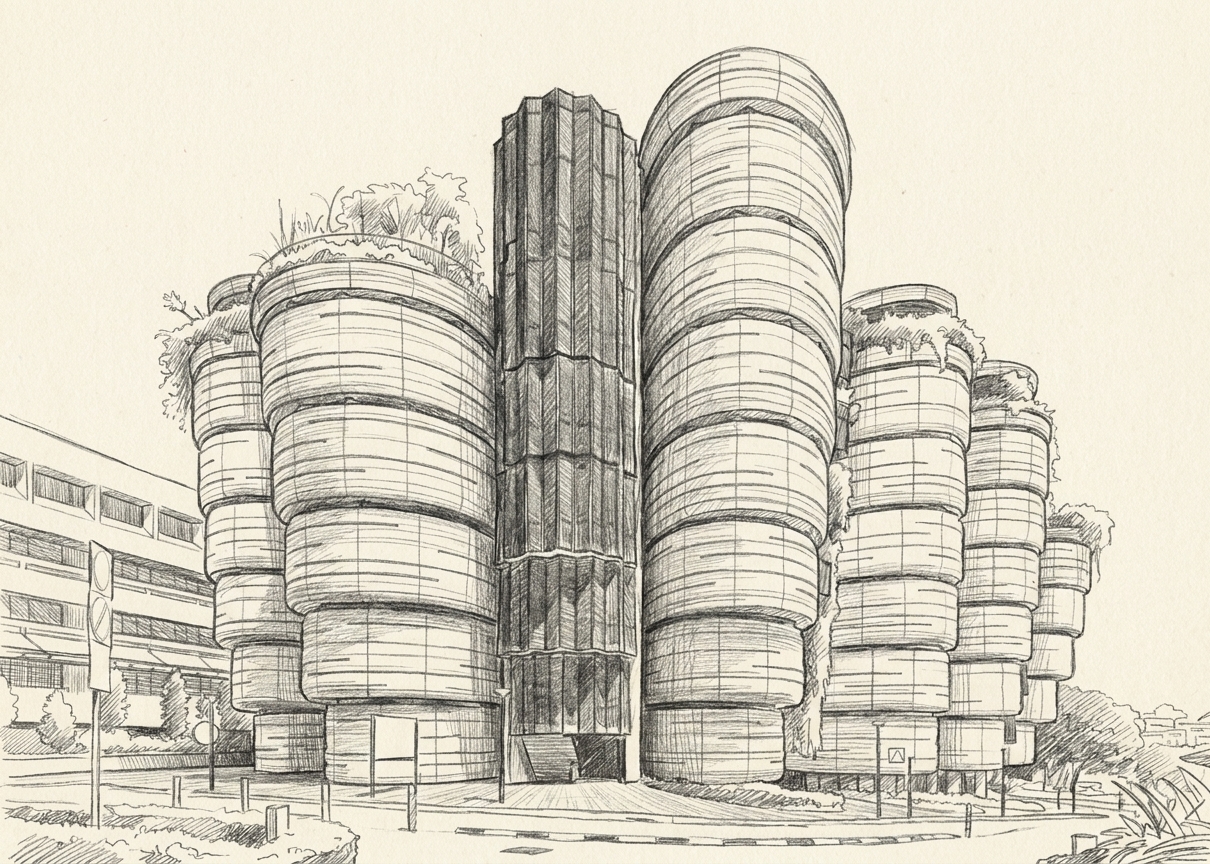
This is the part most comparisons skip, and it's often the deciding factor. NUS's main campus sits at Kent Ridge, in the southwest, with UTown a short internal shuttle ride further in. The nearest MRT is Clementi (EW23) on the East-West Line, connected to campus by a mix of public buses (96, 183, 188, 33, 95, 151) and NUS's own internal shuttle network once you're past the main gate.
| Starting point | Route | Rough door-to-door time |
|---|---|---|
| NUS hall / UTown | Walk or internal shuttle | 5 to 15 minutes |
| Clementi MRT | Bus (96/183/188/etc.) plus internal shuttle to faculty | 20 to 30 minutes |
| Buona Vista MRT | Bus 196 towards Clementi, alight near UTown, short walk | 20 to 25 minutes |
| Dover MRT | Bus 33 direct to NUS | 20 to 30 minutes |
| Queenstown MRT | Direct bus service, roughly 34 minutes on the bus alone | 40 to 45 minutes |
| Jurong East (Ivory Heights area) | EWL to Clementi (a few stops), then bus and shuttle onto campus | 30 to 45 minutes |
None of these numbers include waiting time at a bus stop, which on a bad morning can add another 5 to 10 minutes. A hall room genuinely wins on commute, since nothing beats living inside the campus. But "off campus" doesn't have to mean "far." Clementi, Buona Vista, and Dover are all one MRT line away with a short bus leg on top, which is a very different commute from living on the other side of the island.
The full trade-off in one table
| NUS hall | Co-living | |
|---|---|---|
| Guaranteed place | No, competitive balloting via Freshman Accommodation Exercise | Yes, if a room is available and you can pay |
| Cost (single room, all-in) | ~S$650 to S$1,180/month depending on hostel type, plus a compulsory meal plan in halls and residential colleges | Furnished, all-in rent; check current listings for exact pricing |
| Meal plan | Compulsory in Halls and Residential Colleges; not required in PGPR or UTown Residence | Not applicable, residents self-cater or eat out |
| Guests | Overnight guests strictly prohibited, day guests accompanied and out by a set curfew (commonly ~11pm) | No curfew, no sign-in, house rules are about shared-space courtesy |
| Commute to Kent Ridge | 5 to 15 minutes, on campus or a short shuttle ride | 20 to 45 minutes depending on the neighbourhood and MRT line |
| Term length | Tied to the academic semester or year | Flexible, but Singapore law sets a 3-month minimum for private residential rentals regardless of operator |
| Furnishing | Basic, provided | Fully furnished, move-in ready |
| Independence | Structured, hall committee and warden oversight | Full independence, own routine |
So which one actually makes sense?
If NUS's balloting comes through and you're offered a place, especially in a Hall of Residence for the social side or UTown Residence if you'd rather self-cater and skip the meal plan, that's usually the strongest first-year option. The commute is unbeatable, and even with the meal plan added in, halls can undercut the private market once you're not paying broker's fees or a full security deposit.
If you didn't get a place, you're arriving mid-year outside the normal application window, or you specifically want a room with no curfew and no compulsory meal plan, co-living is a legitimate choice rather than a consolation prize. You trade a five-minute walk to lecture for a slightly longer commute, and you gain a fixed monthly number, a furnished room from day one, and zero balloting risk.
Some students also do both across their degree: a hall for year one while the FAE odds are best and the social entry point matters most, then co-living from year two once term-time friendships are already in place and independence starts to matter more than proximity.
Lazybee runs three furnished co-living houses in Singapore, Chiltern Park, Ivory Heights, and Thomson Grove, each on a different MRT line, with current room availability and what's included shown upfront on lazybee.sg. If the FAE ballot didn't go your way this year, it's worth a look before settling for whatever's left on the open rental market. For the wider first-year picture across NUS, NTU and SMU, our guide to halls vs co-living for first-year students covers all three universities side by side.
Sources: ICA, Apply for a Student's Pass; URA, Short-Term Accommodation guidelines; URA, Renting Property guidelines; IRAS, Stamp duty on renting a property.